"Any intelligent fool can make things bigger, more complex, and more violent. It takes a touch of genius - and a lot of courage - to move in the opposite direction." -E.F. Schumacher

Search This Blog

2017-08-28

Adapting to Florida

I have to say first, that I am not a lover of heat and humidity. That said, Florida is a very poor choice for me to attempt to live, especially as an outdoor enthusiast. On the other hand, it is so hot and I am sufficiently uncomfortable that eating is much more of a chore. Over the past couple years, as my depression worsened, eating made me feel better. While I did not balloon back up to my previous high weight, I did make an attempt at it, and the sixty pounds I put back on certainly adds to the discomfort. However, one of the last things I want to do now is eat, and when I finally do, my portions are much more moderate. Unfortunately the other part of the equation is activity and all I want is shade and a fan while sweat beads up and rolls down my arms.

 Fauna have been entertaining so far. We are currently camped on a little hill which seems to be riddled with ant warrens. We sprinkled some diatomaceous earth around our temporarily claimed territory and they seem to be willing to accept the armistice for now. Our clothing is treated with permethrin and skin gets dusted with picaridin while citronella candles and scented plaques work to against the mosquitoes and ticks. Lizards scatter every time we head to the bathhouse, barred owls hoot at us and bullfrogs serenade from the cypress dome. The ground is soft enough I needed to sacrifice some tennis balls to put over the feet of my chair to stop me from sinking and falling over. A large tarp covers the screen house to help with the heavy rain. So far the Y style stakes are holding in the sandy soil just fine.

A tree, Spanish moss and sun combine for interesting shadows 

Driving is a different experience as well. Just the way things are laid out and traffic patterns are set isn't what I expect. On the drive down, it seemed like once we traveled out of the pit of diaspora which continually spewed from the DC/Baltimore area, there was a significant difference. While Atlanta had some traffic, it just seemed easier to deal with compared to the furious desparation I was accustomed to. Yes there were lane jumpers and the usual shenanigans you get when there is six or seven lanes of congested urban traffic. I want to say it felt more respectful. It was easier to maintain a decent distance between my car and the one in front, and other drivers responded to my turn signals with courtesy. 

When it came to stopping for comestibles or other needs even the people were helpful. Unlike the Martinsburg area where we were typically greeted with gruff "not my department" or other lowest common denominator service. I don't expect much, just some decency. The apparent short supply in that area was a deciding factor in this change of situation. Until moving away I only suspected how inhumane the area was.

2017-08-24

The First Weeks

It was only with great trepidation that the change to a fully nomadic life was embarked upon. Many difficult decisions had to be addressed, assessed, and finally either slain with prejudice or postponed with enthusiastic procrastination. Chief among them was plans to immediately begin an adventure much like an unfortunate Hobbit.
For years I had endured the struggle of moving in the direction of simplicity and modest means but found it difficult to eschew the extravagances foisted upon me by social pressures. I continued to drive the same tired vehicles, held together as much by force of will as by the required repairs. This blog itself was started at a time when switching to laptop from desktop and after losing convenient internet. I continued my wonder whether the technology of the time could further my approach to simplicity and nomadicism. It proved out, but my own inner censor prevented much of the logging of that process. I wonder now if it was mostly an incompatible schedule, which interfered with other aspects of my creative endeavors.
I am composing this from a shady campsite at Amicalola Falls. I am typing on a small Samsung tablet and my internet is through the hotspot on a matching smartphone. The water for my coffee and oatmeal was heated in a stainless tea kettle on a propane stove made by Coleman twenty years ago. In a footlocker to my left there is three weeks' worth of dry goods, I have water filters and other chemical means to make water potable. I have sufficient solar collectors to maintain my electronic devices and various batteries. The site does come with all the power and water I need, but I have the options should a site not have them readily available.
Life has consisted largely of driving hundreds of miles, as per plans. The first night was at a Dispersed Camping Area prior to entering Red River Gorge. The following days were at various campsites with either limited or no amenities, but the assets possessed made life comfortable. Trips were made back to civilization to raid WiFi and eat unhealthy food, only to return to camp, hike and eat camping rations. Other lodging was purchased when we felt the need for machinery to launder clothes and limitless clean water to contaminate with either soaps or other bodily soils.
Eventually we made our way to southern Illinois where the second part of our adventure plans placed us in the path of totality for the solar eclipse. We fought heat and humidity, but persevered. Special photographic filters had not been added to the list per the plan, but extra viewing glasses were on hand to create them with the addition of adhesive tape and things scavenged from the trash. That Saturday night I participated in a transformative activity wherein we walked barefoot upon a pathway of glowing coals of cedar. The eclipse came and went with a few hours devoted to observing and recording it. After this we watched all the others attendees of the festival flee to their social normative existences. Accordingly, we executed the third part of our plans, reducing and prepacking our camp.
I should mention that some time every day was set aside for creative pursuits. Whether that be photo or videography, other graphic arts or processing the photos and videos gathered previously. I do not find it possible to keep up with my collections yet, but it is just a matter of time.
Today's adventure will be the viewing of the falls, which I am presently preparing my equipment for. I would like to take a few longer exposures to capture the flow of the waterfall as a misty, dreamy blur.

2017-08-14

In Every Ending, There is a Beginning

The struggle has been real. I've needed and wanted to relaunch this blog. Yes, again. As I sit here in Red River Gorge, I am reflecting on the things that had to happen to get me here.

This blog has always been about finding, learning to use and replacing outdated technology with newer. The aim being, to simplify and make more accessible a freer lifestyle. To be comfortable accomplishing frequent moves to take advantage of life's opportunities. To become nomadic if that was the desire.

To that end, the past several months have been spent quite literally shedding thousands of dollars of possessions. The purge was extensive and I would be remiss if I did not admit that it was painful. In the end, I feel as though I am close to answering, for myself, an important question. "What does one need to live?" Not just survive, but live. To go about the activities of life, and feeling fulfilled and satisfied.
Turning back time a little, allow me to explain an interest I had when younger. I liked camping, but my family always traveled in an RV of some sort. Us kids were evicted to tents when we parked. I asked a few times about carrying my tent into the woods a ways and my father bought me a copy of a popular magazine devoted to backpacking. The hook was set then and there. Unfortunately that was where parental support ended. I was able to collect some gear, but never everything I needed and requests to try what I had out fell on terrified ears. A class trip to dayhike a trail as part of a science lession didn't help. Soon the desire to hike was set aside because of the misguided expectation to chase the american dream.

About a year ago, while in existential crisis and psychotherapy, the desire to just go for a long walk came back. The topic of the Appalachian Trail came up. Research started, gear was accumulated from my extensive stocks and plans began to be made. One overnight trip later and I decided to jump on it with both feet. No halfway, quit the secure job, dump everything non-essential and go. I am a technology addict, so some things could not be parted. I am an amateur photographer and discovered vlogging. Seems hiking and those things go well together. I have a gift in writing, and morning or evening wordsmithing is also apropos.

To get ready and really decide I wanted to do such an undertaking I completed a section hike on the AT. I started just north of Harper's Ferry and ended on the morning of the sixth day at Pine Grove Furnace to take the half gallon challenge. As out of shape as I was, I still averaged decent miles, and after six days I was ready for a break, but not wanting to stop. Thus the die was cast.

2016-08-16

Power Cooker Pro 6qt

We've cooked a lot of different things since the Power Cooker Pro 6qt was added to our kitchen. One of the first things I cooked was beans since the hour long hot soak, then an hour or more to cook could be shortened down considerably. Honestly, even following the directions explicitly I still overcooked them.
We've gotten rid of all our crockpots since getting this. It's no joke, cooking with a pressure cooker cuts down the cook times dramatically. Instead of loading a slow cooker and letting it run most of the day, coming back later to put the food in containers and wash up, we are doing that ten to twenty minutes later. Controls are very basic, but you do have full control over cook time and the pressure if you want it.
There is no hot cooker slowly heating up the kitchen all day. A big bonus in the hot months. This model does have a slow cooker option, but we haven't used it yet. There is also a rice button, and that does work, don't vent the pressure right away if you're cooking brown rice. The flat disk is for steaming, it rests on the ridge halfway down the inner pot. The instructions say not to use it for pressure canning with the claim that it doesn't regulate the pressure accurately enough. It does so electronically and there is a lag between when power to the heating element is switched back on and it builds pressure back up. 
The power cord is pretty standard, recognize that port? The one that comes with it is pretty short. We haven't needed a longer one, but they are readily available nearly everywhere.
It is important to never overfill this cooker. That Max Fill line is for safety. If the valves in the lid get splashed the vent orifices could become clogged. This could result in a possible overpressure.
Steamer plate in place. A couple cups of water in the bottom and either put the lid on and use pressure, or just leave it venting. There are some things, like asparagus that steam really fast. The cooker would never have time to come up to pressure before it was done.
The seal just drops in behind a stainless ring. It doesn't take too much finagling to get it out or put back in for cleaning. Just be gentle so it doesn't tear. Yes it's loose, but it works just fine. The two fittings are safeties. The upper one is a removable guard over the vent you use to depressurize the cooker. The lower one is a pin that once steam begins to build, will rise up and block the latch to stop you from taking the lid off. It hisses and sputters then goes silent. The silicone washer blocks the small port. All of these things can be removed for cleaning, they're small parts.
The switch just lifts the weight so the cooker can vent when it's done cooking. This unit is electronic, don't cool it in the sink. Remember that sudden drops in pressure can make some food items pop. If you are impatient and vent right after cooking, remember the contents are above the normal boiling point. That's what pressure cooking allows, higher temperatures because you stop the water from boiling away. That doesn't mean food won't burn, I will not attempt lasagna in the pressure cooker again.
And there is the weight popped off. There is a spring clip that retains it so it doesn't get lost or blow off when you vent the pot. The small hole above that is the secondary safety. Don't block either of these. I do like to tent a towel over the vent when I release the pressure to help mitigate the steam that geysers forth.

Overall operation is dead simple. The controls on this one are overly simplistic and there are better ones on the market, most of which are far more expensive than this one which still does the job. The instructions are not all that clear. I recommend trying a few simple things before doing something complex. Like making soup stock. Remember it needs to make steam to get pressure, so always put a cup or two water in it minimum. The pot is non-stick, but the heating element is in direct contact with the bottom of the pot, thus you need to plan your recipe to avoid burning. Mine lives on the counter and gets used at least once a week.

2016-08-08

Morakniv aka Mora Knives

I have several as you can see, starting at the top they are:

Both Craftline knives have seen hard work, the black handled 510 sees use in the kitchen and replaced a paring knife. The red handled 511 is my box opener and a fresh spare is in my large medical kit. The classic 2/0 lives in a pencil jar next to pencils, pens, and hobby knives. I use it when the smaller knives are either just not long enough, or too fragile. I have not used either the Companion nor the Robust regularly. I believe the reputation of Morakniv is sufficient that I do not need to test them harshly. They are both destined to go into bug-out kits.
The Companion and Robust scabbards both have a clip on feature where they can be hooked over a belt or pantwaist. The slots on both sides of the button attachment also make a good place to thread a lanyard. I have attached the scabbard of the Companion to the scabbard of the Robust and it locks on very firmly. Most metal blue jean waist buttons also seem to the be same size, so any jacket with the extra buttons around the waist to cinch the bottom tighter can be an attachment point. All of the scabbards except the Classic 2/0's have drain holes in the bottom and a positive feeling click when the knife is inserted fully. The black handled 510 and the Classic 2/0 are ambidextrous. The Classic 2/0 is retained only by friction, and while it has not fallen out, I do not trust it not to without modification. I plan to use a heat gun to soften the plastic scabbard and increase the contact area.
This is a top down, showing how much thicker the blade is on the Robust. The handle is also significantly larger. I can get a much meatier grip on the Robust, my fingertips just touch my palm. With the Companion I have a fully wrapped grip. None of these knives have a sharp edge on the back for use with a firesteel, and in the case of the Robust is actually beveled. All knives were shaving sharp when I received them and resharpen readily. The scandi grind is a time-tested classic and so is the laminated blade construction. Several major high-end manufacturers also use a similar construction.

Like so many other things that come my way and I have the ability to spend a long time working with, Moras are a pleasant blend of old and new technologies that do not break the bank. All of these knives go for less than twenty dollars, and you have a choice of old school wood, impervious utilitarian plastic or rubberized composite handles. There are also stainless versions available now if you'd rather not watch your shiny blade acquire its own unique patina. They are often viewed as starter knives for budding outdoorspersons but they have a long history and there is no reason not to have a knife such as a Mora in your kit if they fit within your plans.

2016-08-01

Wonderbag

As always I like to find products and companies that I feel give back to communities and help alleviate poverty related issues in developing countries. The Wonderbag is such a product. A Wonderbag is essentially an insulated cooker. You combine your ingredients in a pot, bring it to a good, hard boil and put the pot in the bag. The food then continues to cook slowly on the remaining heat energy.

The Wonderbag arrives in a vacuum bag and must be fluffed up and allowed to fully decompress before using. You can put a pot of hot water in the bag or set it in a warm place to speed up the process, but it needs several hours or overnight. It will continue to fluff up over the first couple uses. It is recommended to wrap your pots in a towel and place a folded towel in the bottom. This is to prevent soiling the Wonderbag, catching stray condensation and in the case of cast iron to prevent damaging the fabric. I use a silicone hot pad for the bottom of the bag.
Just loosen the drawstring and place the pot in the bottom. Cover with the top and pull the string until the bag is closed up, it doesn't need to be tight.
The pot you use can be quite large, though today I used something less than three quarts. I made quinoa in a microwave cooker, after a few minutes of boil time I put it in the Wonderbag. Actually I forgot about it, but it wasn't overdone, and cool enough to put it in the fridge. No big deal as it was destined for a chilled quinoa salad.
The inside of the bag is about fourteen inches across, and as you can see, the insulation pillows puff up a good bit so be mindful that a fourteen inch pot may not fit well. The key is the insulation which needs to not get excessively compressed. I should note the bottom is actually semi-rigid closed cell foam, the remainder is shredded reclaimed open cell foam.
The pot can also be quite deep, though remember big handles or knobs will likely get in the way. I usually put an old pillow on top just as an extra layer of insulation, and when the bag is not in use, I stuff it in the Wonderbag to help it keep it's shape when stored. I keep mine on top of the kitchen cabinets so it's always ready. Some people toss it on the couch as a throw pillow. You can also use the Wonderbag to keep things cool, insulation is insulation. It also works well for holding hot food during transportation to pot lucks, or just around the holidays in a crowded kitchen. Those casseroles will be just fine in the Wonderbag and moved into the dining room, out of the way. I have also used it for rising bread and on a cold day put a heating pad around the bowl, plastic over the top, and a thermometer to make sure I don't kill the yeast.

Cook times are much like using a crockpot on low, but you need to keep an eye on the temperature. If it cools too much, you'll be taking a risk of bacterial growth. Better to put the pot back on the stove before it gets too cool and heat it up and put it back in the Wonderbag. Generally speaking it takes hours before there is a problem. It also depends on the overall mass you put in the Wonderbag. Mostly full, heavy pots near the size limits of the Wonderbag will have the necessary mass to last long enough to do the difficult things like beans.

2016-07-25

Hot Logic Mini

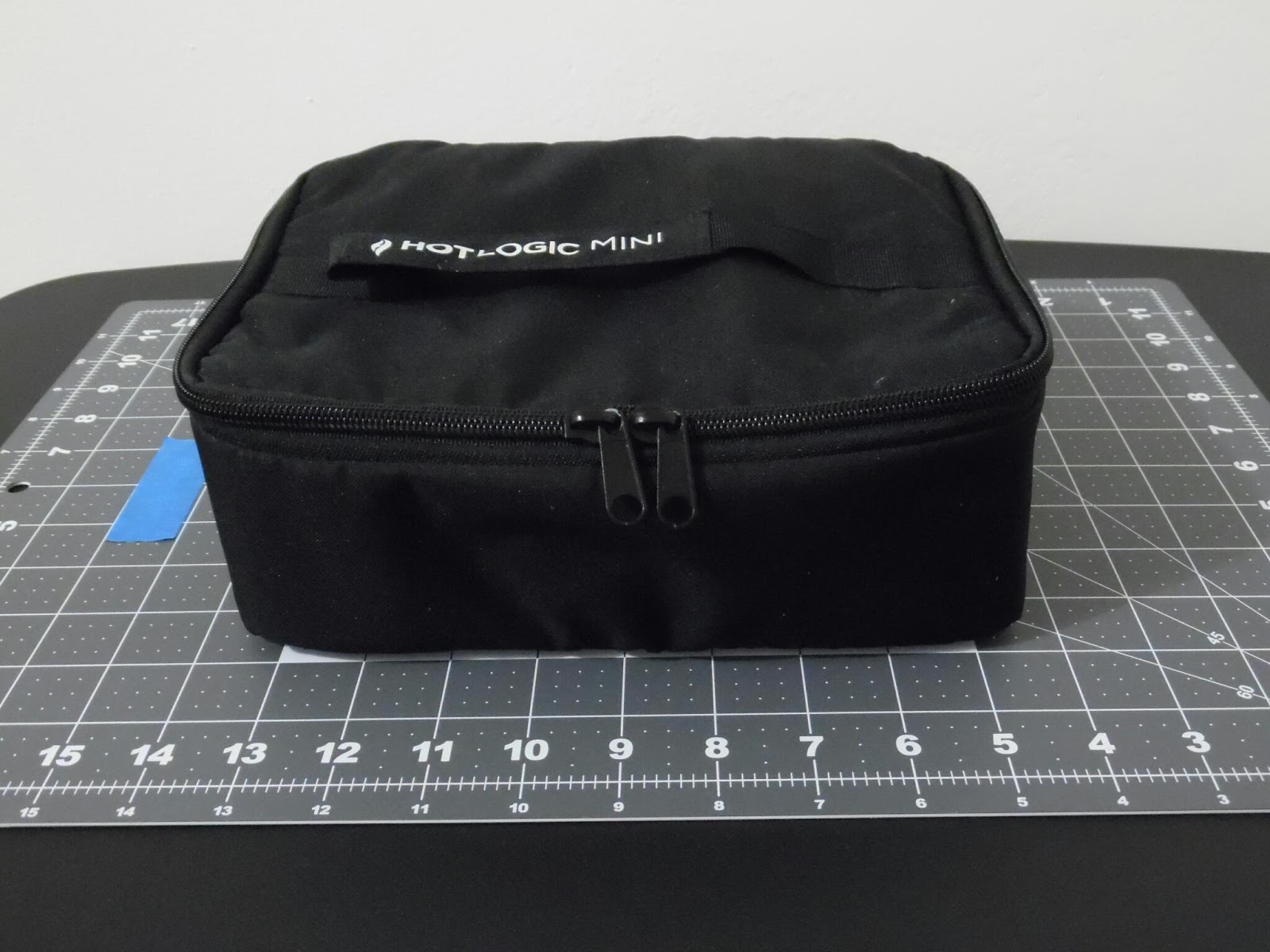
The Hot Logic Mini is a small, portable, electric food heating device. I have had mine for about three months or so. I did not buy it with the pyrex baking dish, I sourced that locally from the grocery store.
The case appears to be nylon with an insulating layer. There is a fabric handle on top and inside is what looks like woven aluminized polyproplyene or mylar. The hot pad itself is slightly smaller than the case and has a power cord with a decent length. I did not measure it, but it's about four feet long. There is a slit in the middle of the rear of the case to feed the cord through. Generally though, the plate just stays in the case.
Here is the data plate on the bottom. 45W isn't much and that makes it critical to have as much contact area as possible. I have seen cooking temperatures in chicken breasts reach 160F. I also experimented with food service grade plastic trays, food cooked faster in them and tended to dry out easily. It is imperative that containers have tight fitting lids.
There is a tunnel on the back of the case where the cord can be rolled up and stored.
This is what the six cup pyrex dish looks like in the Hot Logic Mini. It is a good fit and zips up fine. I have also used a three cup dish with a little foil in the bottom to reheat frozen burritos and a four cup round to make oatmeal. Typically I give it two hours to work for most of the cooking I've done with it so far. Brown rice is the only failure I've had, so I precook that prior to using it in the Hot Logic Mini. 
For the most part I use the Hot Logic Mini to help keep myself to a diet and reduce my instant gratification cycle. Instead of heating something up in the microwave, I put something together in one of the pyrex dishes I have and try to forget about it for a couple hours. I have also used it to hold hot food while I cook other parts of a meal, like the bacon so I can make dirty eggs or a stack of pancakes so everyone gets to eat together.

Depending on what you want to cook, this can almost replace a crockpot. While brown rice and beans can be done in a crockpot, the Hot Logic Mini doesn't have the horsepower to be successful with them. That said, if you keep in mind the limitations of the lower temperature there is still a lot that can be done. If you work a job where you don't have a set lunch break or that break is easily interrupted, this is an excellent tool to free you from that time constraint. As I mentioned before, about two hours seems to be about when frozen vegetables become al dente (except carrots unless sliced thin) so whether you're cooking or reheating seems like a good timeframe. If your meal is interupted, just close it up, leave it plugged in, and when you come back to it it'll still be hot. Remember to use good food safety practices. I have also had good luck with a variety of frozen microwavable meals, just leave them sealed up or transfer them to something with a tight lid.

Size-wise, as can be seen in the pictures, the Hot Logic Mini is about the size of a child's lunchbox, or a large bento. Even with the six cup pyrex there is just barely room for an icepack, two if you take out the heating plate. So you could use it for a cooler if necessary.